Currently, the most commonly used disinfection methods primarily involve irradiation with either a single-wavelength 254 nm or dual-wavelength 254 nm/185 nm low-pressure mercury lamps. Although this approach is simple and effective, it presents certain drawbacks. For instance, the mercury in low-pressure mercury lamps may cause environmental pollution. Additionally, these lamps tend to generate ozone and must be operated in unoccupied environments; inadequate ventilation after use can pose health risks to occupants. Consequently, under the need to balance high sterilization efficiency with personnel safety, 222 nm far-ultraviolet light is gradually replacing traditional 254 nm UVC as the preferred disinfection method.
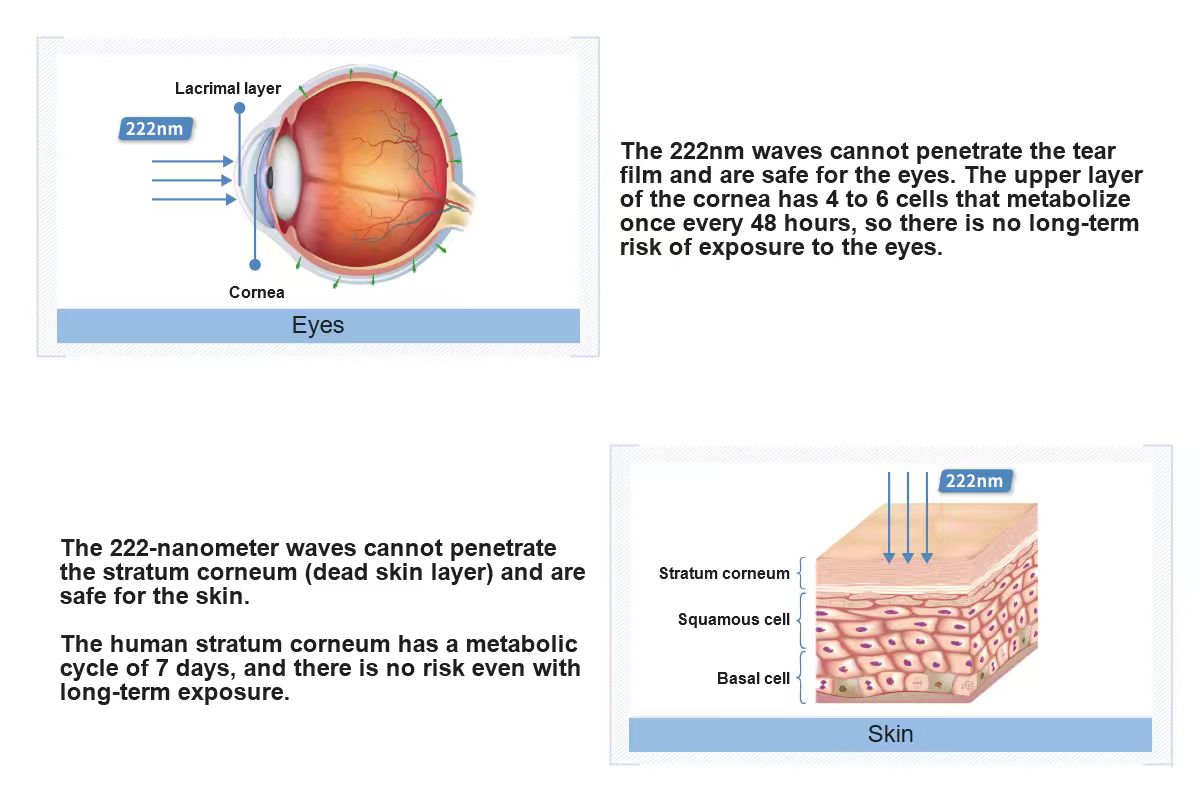
The 222 nm wavelength falls within the far-ultraviolet range of 200–230 nm as defined by the International Ultraviolet Association. In addition to its traditional sterilizing effects, it exhibits the following characteristics:
(1) Compared to 254 nm, 222 nm ultraviolet light has weaker penetration capability; its wavelength is primarily absorbed by the stratum corneum and tear film of the eyes, preventing penetration into deeper living cells. Under compliant dosage levels, it can be used continuously in the presence of personnel, completely eliminating the risks of skin burns and ocular damage associated with conventional UVC, thereby overcoming the limitation of "disinfection requiring unattended operation."
(2) 222 nm far-ultraviolet light achieves highly effective sterilization by rapidly destroying the DNA/RNA and protein structures of bacteria, viruses (e.g., COVID-19, influenza, MRSA), and fungi, demonstrating efficacy against microorganisms in the air, on surfaces, and in aerosols without any disinfection blind spots.
(3) Since 222 nm ultraviolet light is more readily absorbed by proteins within biological organisms, microbial repair becomes more difficult, and its penetration is significantly reduced due to this process, minimizing damage to the internal structures of larger organisms such as cells. Long-term low-dose exposure poses no health risks, making it suitable for routine disinfection in human-centric environments.
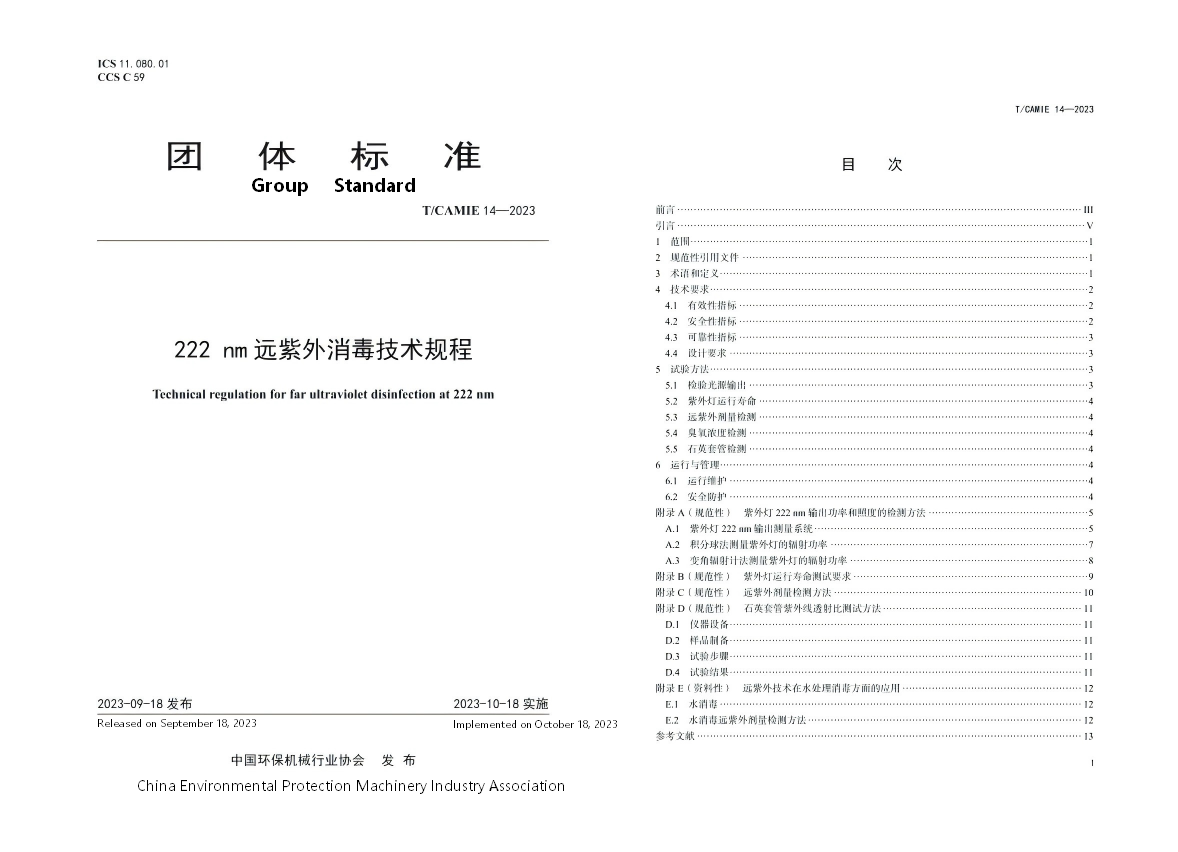
Compared with 254 nm ultraviolet light, the advantage of 222 nm ultraviolet light lies in its dual efficacy of sterilization and disinfection, while theoretically causing no harm to the human eye or skin. For the stable and high-purity output of the 222 nm far-ultraviolet wavelength band, the current mainstream and commercially mature technical solution is only the excimer lamp; other technical approaches either fail to achieve this wavelength band or suffer from drawbacks such as low power output, short lifespan, and impure spectra. In 2023, the China Environmental Protection Machinery Industry Association issued the "T/CAMIE 14-2023 Technical Specification for 222 nm Far-Ultraviolet Disinfection," which outlines specific requirements for the disinfection process using 222 nm excimer lamps.
(I) Effectiveness Indicator
1. Disinfection efficacy: The natural inactivation rate of bacteria in the air and on surfaces within 24 hours is ≥90.0% (evaluated in a closed space of 25 m³ with no personnel entering or exiting).
2. Dosage Requirements
l Air disinfection: Average radiation irradiance>0.1 μW/cm², with an average radiation dose of ≥0.39 mJ/cm² over 1 hour; medical institutions must comply with the GB 15982 standard.
l Surface disinfection: Ultraviolet dose ≥4.5 mJ/cm²; medical institutions must comply with the GB 15982 standard.
3. Illumination requirements for the light source at 1 m (corresponding to different power levels)
Light source power (W) | 15 | 20 | 35 | 75 | 150 |
measuring distance (m) | 1 | 1 | 1 | 1 | 1 |
Light source illuminance (μW/cm²) | 3.5 | 8 | 14 | 32 | 56 |
(II) Safety Indicators
1. Human exposure threshold: The radiation dose received by the human body within 24 hours shall be ≤150 mJ/cm²
2. Jamming ratio: The ratio of jamming spectrum (235 nm–320 nm) to the main wavelength spectrum (200 nm–230 nm) under vertical illumination is <3%.
3. Ozone concentration: Under standard conditions, the average ozone concentration at a height of 1 m after 1 hour shall be ≤0.1 mg/m³.
(III) Reliability Indicators
1. Service life: Average operating time ≥ 3000 h, with radiation flux during service life ≥ 70% of the nominal value.
2. Switch frequency: Frequent startup scenarios (lights turning on/off when people enter)> 100,000 times; Non-frequent scenarios> 10,000 times
3. Stability: Within 10 seconds after startup and after 1 hour of stable operation, the radiation illuminance shall be ≥90% of the nominal value.
4. Lamp heating: After 20 minutes of operation, the external temperature shall not exceed 60°C.
5. Failure rate: ≤5% within 3000 hours
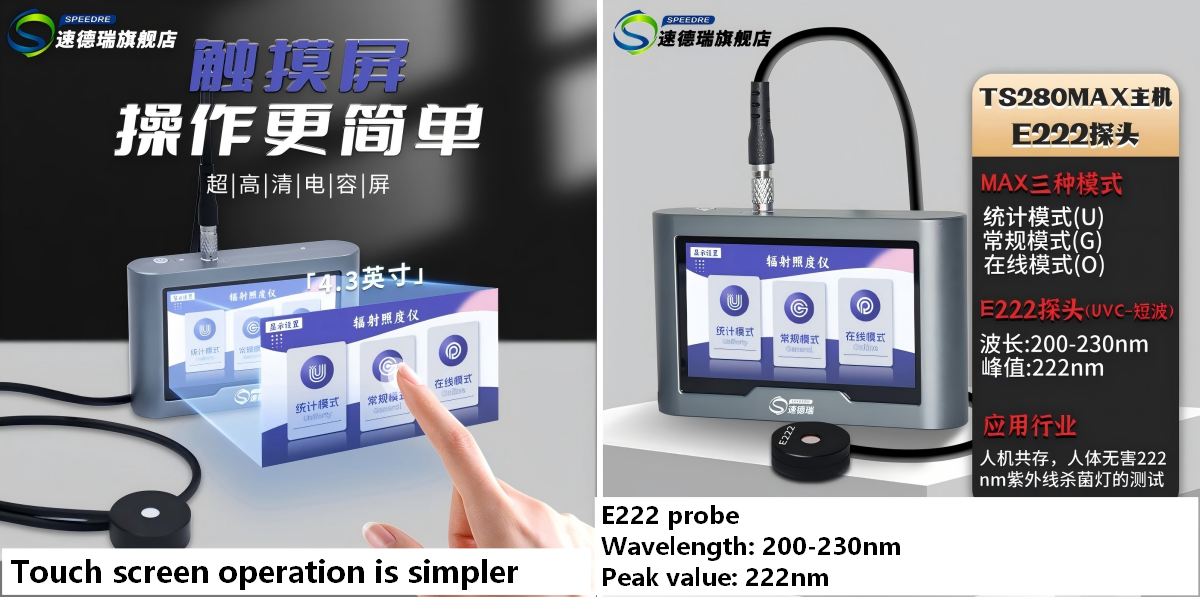
The Speedre TS280, paired with the E222 sensor, is a precision detection solution for short-wave UVC applications operating in the 200–230 nm range. The E222 sensor is specifically optimized for the 222 nm peak wavelength band, ensuring seamless compatibility with emerging devices such as excimer disinfection lamps and deep ultraviolet curing light sources. It addresses the limitation of conventional sensors in measuring short-wave UVC radiation. Combined with the host unit's ultra-fast sampling rate of 2,048 samples per second and high-precision error tolerance of ±5%, the system reliably captures accurate data even in low-light conditions. Both the host and sensor feature a plug-and-play design with aviation-grade interfaces that lock securely upon connection. Calibration data is stored in the host unit, eliminating the need for repeated calibration. The system's 1-billion-range automatic switching capability enables single-unit operation across multiple scenarios, significantly reducing procurement and portability costs. The 4.3-inch touchscreen offers intuitive operation, and the entire system complies with authoritative standards such as JJG879-2015, enabling the issuance of CNAS-certified reports. This ensures compliance and quality assurance in medical disinfection and laboratory research applications, balancing professional rigor with practical usability.