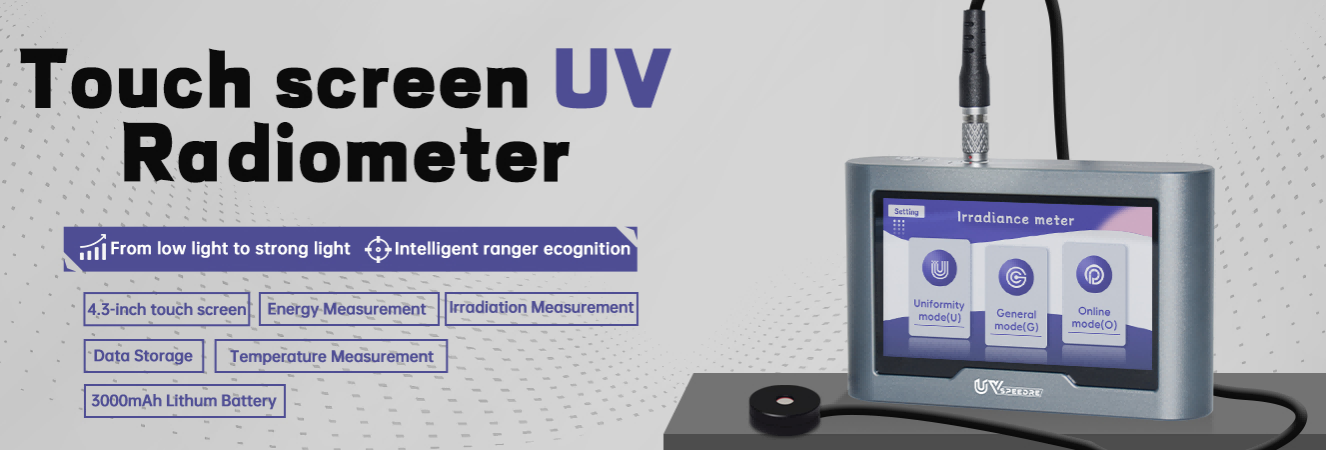
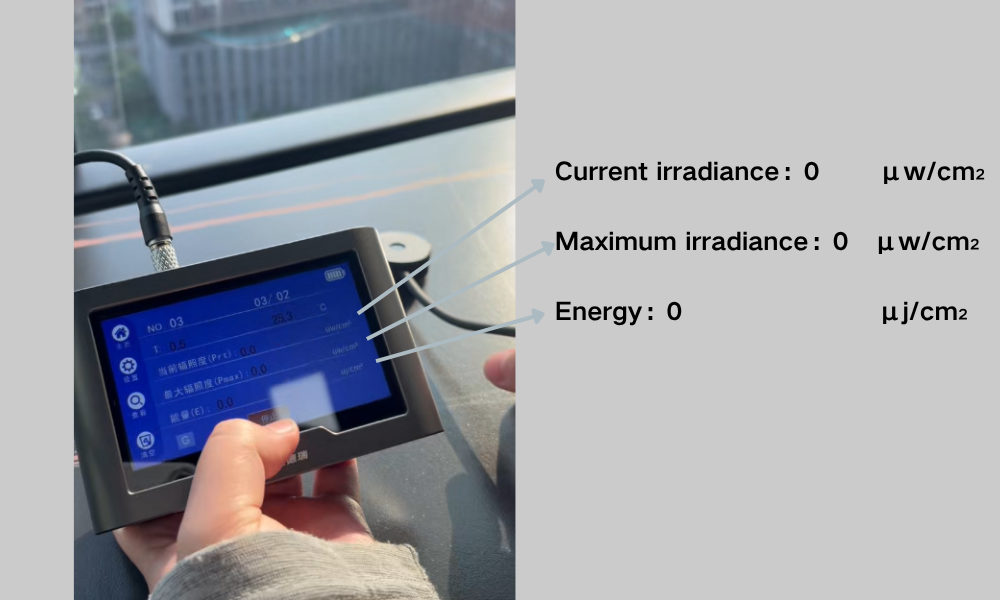
Recently, a customer conducted a test using the Speedre’s TS280MAX touch-screen UV irradiance meter: after bringing the device outdoors and aligning it with sunlight, the customer intended to directly measure the UV intensity to verify the instrument's performance. An interesting phenomenon was observed: when the E297 or E365 probe was used and the sunlight was aligned with the device, a measurable value was obtained; however, when the E254 probe was used and aligned with the sunlight, the instrument showed almost no response, with a reading close to 0.
The customer's first reaction: "Could the probe be broken? Why has the UV irradiance meter failed before it has even been used?" In fact, it is not a failure of the instrument; rather, it is determined by the probe's spectral response characteristics.
Ⅰ. E254 day-blind probe: detects only short-wave UV at 254 nm
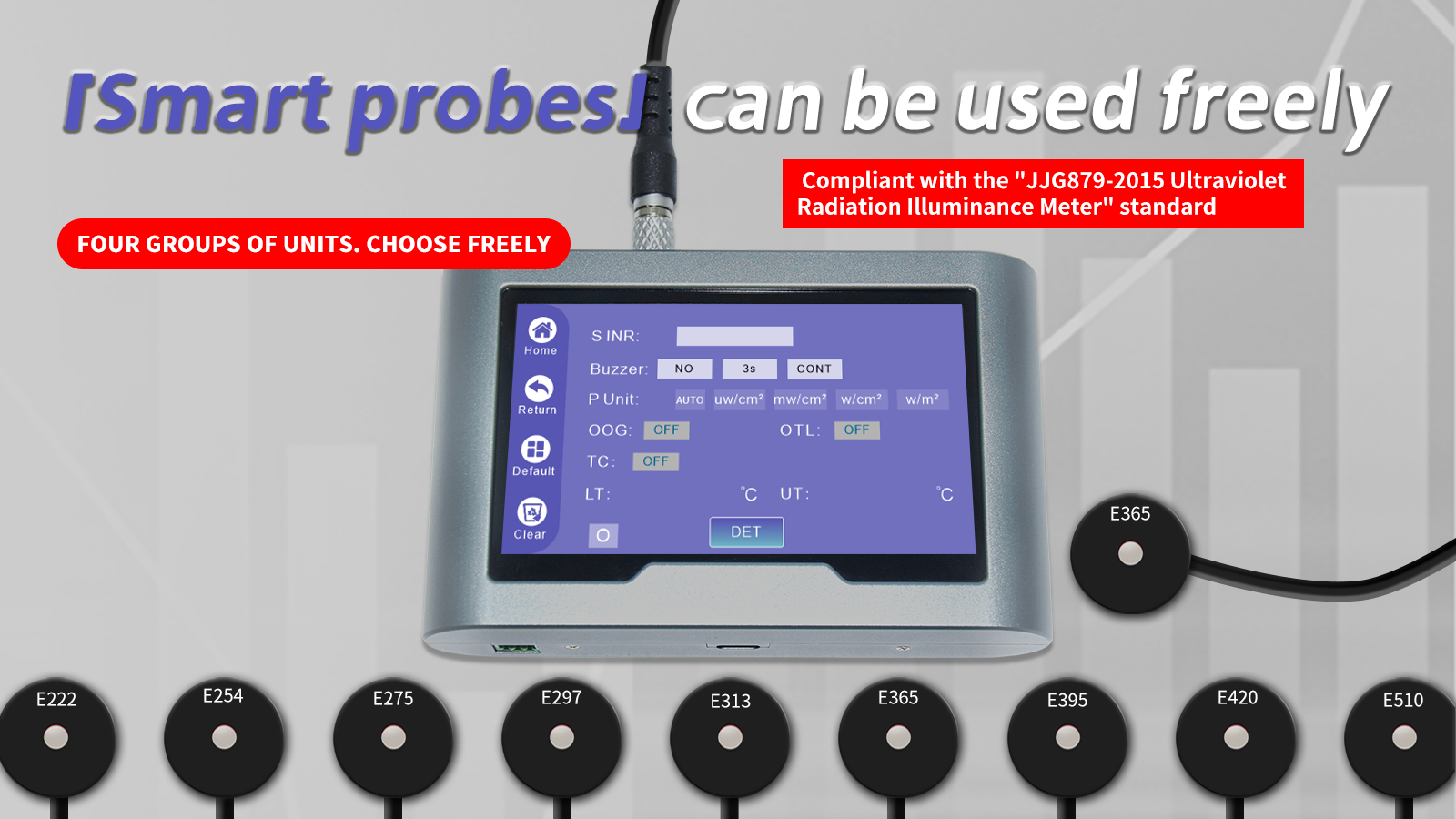
The E254 is a sun-blind ultraviolet probe whose photosensitive band is specifically tuned to 254 nm—the characteristic wavelength of commonly used UV sterilization lamps. "Sun-blind" means that the probe is insensitive to ultraviolet radiation in sunlight. After sunlight passes through the atmosphere, the 254 nm band is almost entirely absorbed by the ozone layer; consequently, sunlight reaching the ground contains virtually no 254 nm ultraviolet radiation. Therefore, when the E254 probe is pointed toward the sun, no corresponding ultraviolet signal is detected, and no data can naturally be obtained. It was designed specifically for measuring the 254 nm ultraviolet irradiance from UV sterilization lamps and low-pressure mercury lamps, shielding against interference from ambient sunlight and indoor stray light, and preventing measurement errors caused by ambient light in the field.
Ⅱ. Why do the E297 and E365 provide readings when measuring the sun?
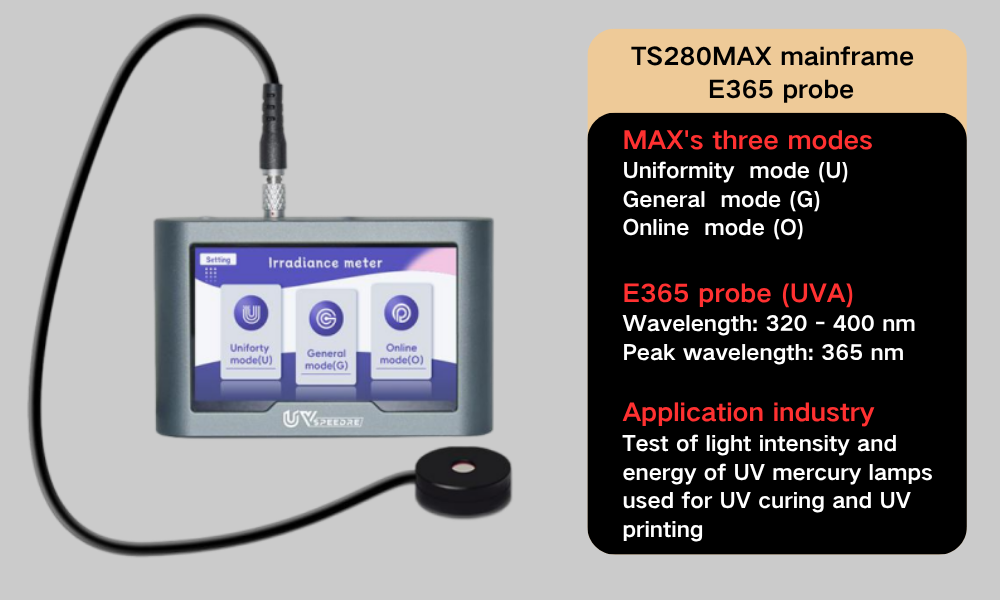
E365 probe: Responds to UVA long-wave ultraviolet radiation (365 nm). UVA accounts for a high proportion of sunlight; outdoor measurements can therefore yield readable values, making this probe commonly used in aging tests and UVA ultraviolet detection.
E297 probe: Responds to the UVB band (297 nm). Since UVB radiation is present in sunlight, readings can be obtained under outdoor sunlight, making it suitable for detecting solar UVB and ultraviolet-induced aging.
A simple way to distinguish them: E254 (254 nm solar-blind) is used to measure germicidal lamps and does not respond to sunlight; E297 (UVB) and E365 (UVA) can detect the corresponding ultraviolet bands in sunlight.
Ⅲ. Practical Tips
A zero reading from the E254 probe does not necessarily indicate that the probe is damaged; when tested under a 254 nm UV sterilization lamp, data will appear immediately, which is a normal phenomenon.
Do not use the E254 probe to assess outdoor solar ultraviolet intensity; for solar ultraviolet measurements, select the E297/E365 probe.
The TS280MAX UV irradiance meter unit itself is universal; its readings are determined by the spectral characteristics of the attached probe, and switching probes allows you to change the measurement band.
The TS280MAX UV irradiance meter unit serves only as the data acquisition unit; whether it actually detects a particular ultraviolet wavelength depends on the probe. The E254 solar-blind probe is inherently "blind" to sunlight—this is precisely the advantage of a solar-blind probe: when measuring disinfection lamps on-site, it is not affected by ambient sunlight interference, resulting in more stable and accurate measurements.