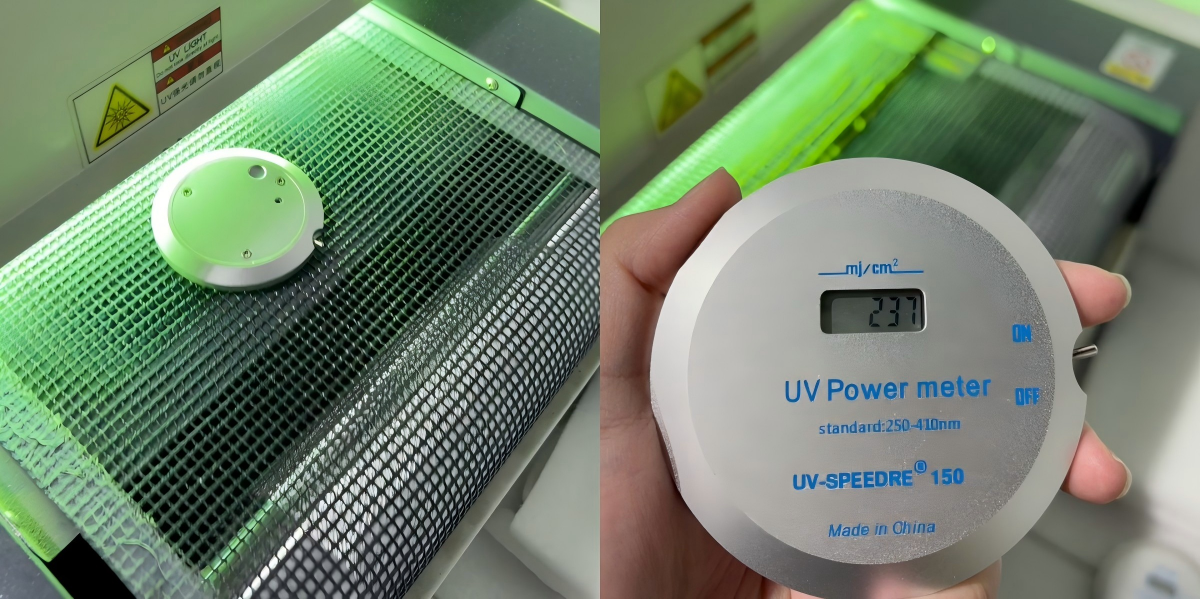
During the UV curing production inspection process, many operators may observe that when using the same UV energy meter to perform repeated measurements on the same curing machine, the measured UV energy values are never exactly identical. These value discrepancies can be categorized into two types: one involves small deviations—which represent normal fluctuations that are unavoidable during equipment operation; the other involves substantial discrepancies—where the values fluctuate unpredictably, either rising or falling—indicating significant variations caused by equipment, operational, or instrument malfunctions; these scenarios are described in detail below.
I. Minor numerical discrepancies are considered normal.
The essence of UV energy is defined as the product of ultraviolet instantaneous intensity and irradiation time; since no measurement system operates in an absolutely constant ideal environment—where it would be unaffected by objective factors such as the power grid, equipment, instruments, or light spot distribution—the measured values cannot be exactly identical, and minor deviations cannot be completely eliminated:
1. The factory's mains power supply experiences slight voltage fluctuations, which may slightly alter the output intensity of the UV light source;
2. Changes in the furnace airflow induce slight temperature variations in the lamp tubes, resulting in minor fluctuations in UV output;
3. Slight variations in the conveyor belt's frictional resistance result in minor differences in its instantaneous speed;
4. The energy meter itself has inherent factory-set measurement tolerances;
5. The intensity at the center and edges of the spot is uneven; even a slight misalignment can result in discrepancies in readings.
Judgment criterion: When standard operating procedures are followed and equipment preheating is complete, if the energy difference measured across three consecutive measurements is ≤ ±5%, this is considered a normal fluctuation caused by the equipment or the environment and does not affect production control.

II. Deviation exceeding ±5% or significant fluctuation in readings (rapidly rising or falling)
If multiple measurements show energy difference values exceeding ±5%, or if the readings exhibit no consistent pattern and poor repeatability, these conditions do not constitute normal operating conditions; instead, they may be caused by operational errors, curing machine malfunctions, instrument aging, or interference from the field environment. In such cases, it is necessary to systematically troubleshoot the following categories of potential causes:
1. Non-standard human-operated procedures
(1)Non-uniform placement of the instrument's photosensitive aperture: one aperture is centered while the other is offset left or right; or the photosensitive aperture is tilted or elevated by the material, resulting in a significant disparity in the total amount of ultraviolet radiation received by the photosensitive surface;
(2)Photoreceptor window contamination: adhesion of ink, adhesive, and dust; the degree of coverage varies each time, significantly reducing UV reception;
(3)Insufficient preheating of the curing oven: when measuring immediately after startup, the power output continues to rise during the heating process of the lamp tube, resulting in a significant temperature difference between consecutive measurements;
(4)Failure to reset to zero before measurement or low battery level: insufficient battery voltage may cause unstable integral sampling and erratic reading jumps;
(5)Band mismatch: When using a mercury lamp energy meter to measure a 395 nm UV-LED, the spectral response is shifted, and the readings exhibit extremely poor repeatability.
2. The UV curing machine's light source system is unstable.
(1)Tube aging failure: blackening at both ends of the lamp tube, whitening of the tube wall, filament degradation, continuous significant reduction in UV output, and noticeable fluctuations in light intensity upon each startup;
(2)Accumulation of contaminants on the reflector and oxidation-induced yellowing: the reflectivity efficiency decreases significantly, with varying amounts of furnace dust adhering to the surface in each cycle, resulting in substantial variations in the ultraviolet intensity reaching the workpiece;
(3)Ballast/transformer fault: component aging, abnormal heating, continuous fluctuations in output power, and intermittent variations in lamp intensity;
(4)Heat dissipation fan failure: filter screen is clogged, fan rotational speed is unstable, the lamp tubes experience severe alternating heating and cooling, and the UV output exhibits significant fluctuations.

3. Transmission system failure
(1)Belt slippage or roller wear; variable operating speed (sometimes faster, sometimes slower);
(2)When inverter parameters are modified and the speed is not locked, the measured forward and backward speeds will be inconsistent; the speed directly determines the exposure time, and any speed fluctuation exceeding 5% will cause the energy output to exhibit a corresponding deviation in magnitude.
4. Internal malfunction of the UV energy meter
(1)The photosensitive holes undergo long-term aging due to intense UV irradiation, resulting in severe sensitivity drift and substantial discrepancies in repeated measurements;
(2)The instrument has not been calibrated for an extended period; the integrator circuit exhibits severe temperature drift, and the readings within the high-temperature furnace show persistent offset.
5. Workshop Environmental Interference
(1)The exhaust airflow is unstable; the ozone concentration within the furnace fluctuates; the energy readings for ozone absorption in the short-wave ultraviolet range continue to decrease and exhibit fluctuations;
(2)Natural light from the workshop, along with stray light from other UV equipment directly illuminating the furnace body, superimposes on the baseline UV values, with the degree of interference varying each time.
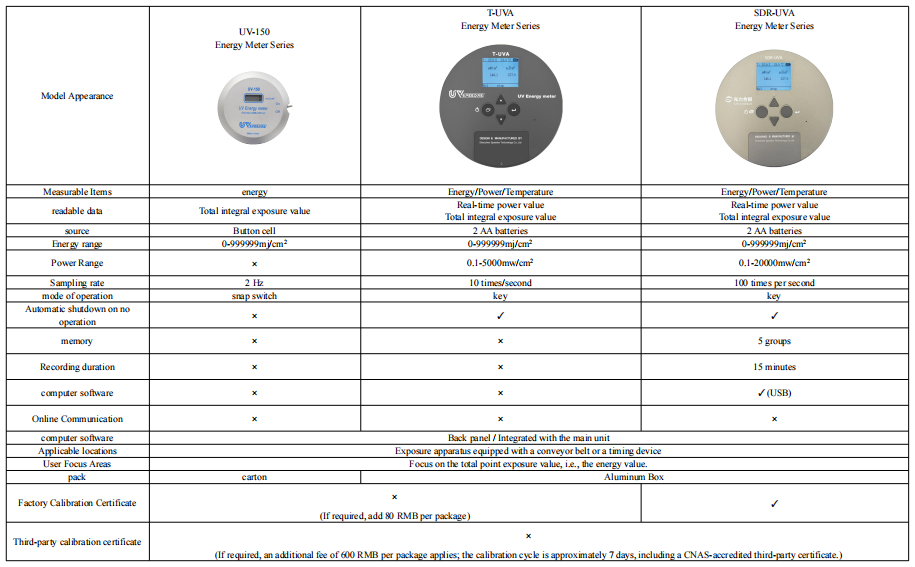
III. Troubleshooting Methods
1. The difference between three consecutive measurements taken at the same location is <±5%.
➡The instrument and operation are functioning normally; any fluctuations are attributed to: variations in workpiece placement, occasional voltage fluctuations, or slight tube attenuation—all of which fall within normal tolerances.
2. For the same position, three consecutive measurements show differences> ±5%.
① Replace with a new battery + wipe clean the photosensitive aperture + ensure strict centering and horizontal placement; if fluctuations persist after re-testing: the machine's lamp tube, power supply, or conveyor system may be faulty;
② Stable readings after proper cleaning and placement: This was previously caused by contamination of the operating surface or the photosensitive aperture.
③Long-term readings continue to decline with significant fluctuations → the photosensitive hole's photosensitive layer has aged; the instrument requires return to the manufacturer for calibration or replacement of the photosensitive hole.
3. Quick Verification Tips
Keep all other conditions constant and perform five consecutive measurements:
①Perform a retest after replacing the battery only: if the readings remain stable, this indicates a battery power issue;
②Re-measurement of the light-sensitive aperture: Stable value = Window contamination;
③Allow the machine to preheat fully for 30 minutes before testing: if the readings remain unstable, it indicates that the lamp tube has not reached a constant temperature;
④Perform a test at the same location using a different spectroradiometer in the same wavelength band: The stability of the new instrument = the aging-induced drift of the photosensitive aperture of the original instrument.